
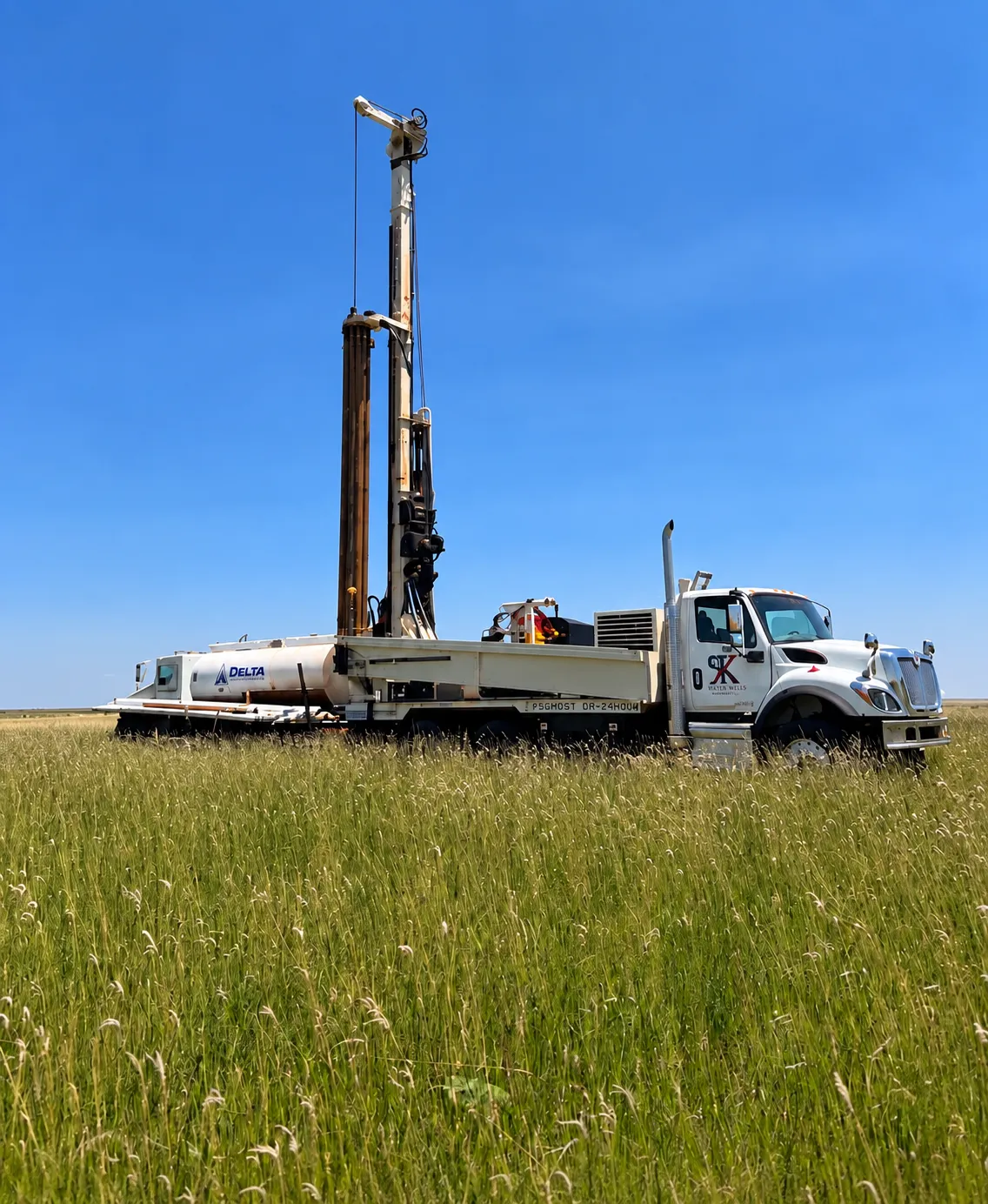
How mud rotary drilling works
A mud rotary rig turns a drill bit on the end of the drill pipe. While the bit cuts, drilling fluid is pumped down the inside of the pipe, out through the bit and back up the hole. The fluid does two jobs. It carries the cuttings to the surface, and it supports the wall of the hole so loose ground does not cave in.
When the hole reaches depth, the casing and well screen are lowered in, with the screen set against the water-bearing gravel. A gravel pack goes in around the screen. Then the well is developed, which clears out the drilling fluid and fine material.
Why that matters here
The Ogallala under Parmer, Bailey, Castro, Deaf Smith, Lamb, Curry and Roosevelt counties is unconsolidated sand, gravel and caliche sitting on the red bed. The saturated section is thin, averaging 44 feet in Parmer County and 61 in Bailey, and it is thinner on some sections than others.
- The hole stays open. Drilling fluid supports loose sand and gravel until the casing is in.
- Cuttings come to the surface. The drilling fluid carries them up as the hole is drilled.
- Casing, screen and gravel pack. They are set in the open hole once it reaches depth.
- Development. Developing the well clears out the drilling fluid and fine material.
Our rig
| Rig | DrillMax 450 (Geoprobe DM450) |
|---|---|
| Type | Truck-mounted rotary drilling rig |
| Drilling method | Mud rotary |
| Well sizes | A variety of well sizes |